“Why did TPET go crazy today?” The real story behind a 70% one-day spike

If you had to pick the loudest small-cap energy name in the U.S. market right now, it’d be hard not to mention TPET. We’re talking more than a 70% jump in a single day, a 160%+ spike just before that, all while the company is tweaking its ATM equity offering size and lining up initial output of around 30–40 barrels from its Alberta wells. In this post, I’ll walk through why it’s moving like this, where the story ends, and where the real risk begins.
💡 3-second key takeaways
- Today TPET ripped more than 70% in a single session as Middle East tensions and the oil spike trade heated up again, putting it at the center of the small-cap oil theme.
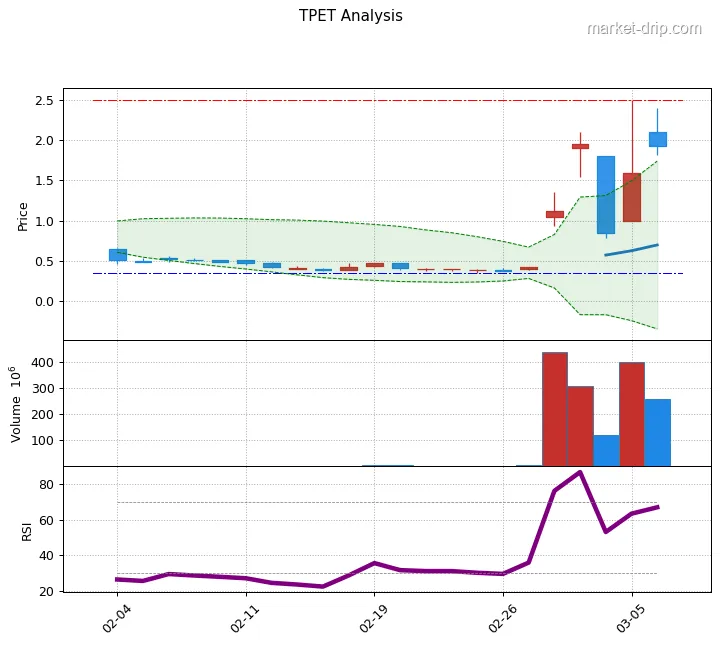
- Trading value also shot up into the 500 million dollar range, a clear sign that retail and short-term money rushed in all at once, and over just a few days it’s swung more than 100% like a classic roller coaster stock.
- So at this point it feels more comfortable to see it from a small, short-term angle that can handle this volatility, rather than as a long-term holding you’d build a core position around.
Market Story
U.S.
oil-related headlines have heated up again, and whenever talk of U.S.-Israel-Iran tensions or the Strait of Hormuz pops up, small-cap oil names start to shake—among them, TPET has been one of the strongest movers.[web:34]
If we boil the market narrative down, it’s pretty simple. “The Middle East looks unstable → oil could spike further → microcap oil stocks with room to grow production are the levered bet.”[web:34] That’s the story arc people are buying into.
It’s less about policy or regulation and more a theme trade riding on geopolitical headlines, with things like the Alberta field update sprinkled in as a kind of seasoning to juice expectations.[web:47][web:49]
Price Trends & Momentum
As of early March, TPET has single days where it’s jumped more than 70%, and there are records of it spiking around 160% right before that.[web:34] At that point, comparing it with an index or sector doesn’t make much sense—it’s playing its own game.
On top of that, there have been days when roughly 500 million dollars of trading value flowed through, which is extreme versus its usual activity and screams short-term traders and retail piling in rather than long-term capital.[web:34] With a chart like this, it’s really hard to draw a line between “normal pullback” and “overdone.” The stock has already swung 2–3x in just a few days, so it feels more like a spot where “when does it take a breather?” matters more than “can it go even higher from here?”[web:34]
Key Catalysts & Risk Factors
First, there was a company update on the Canadian Alberta field saying two wells will start up soon, and they’re expecting initial production of around 30–40 barrels per day.[web:47][web:49] The absolute number isn’t big, but psychologically, “they’re actually about to start pumping oil” hits differently.
Second, there’s the ATM (at-the-market) equity offering program.
In recent filings, the company reset the amount of stock it can sell via the ATM at about 3.29 million dollars, after already having sold roughly 3.6 million dollars’ worth into the market.[web:32][web:52] In plain language, that means the company needs cash and can drip more shares into the market when the price pops, while investors have to live with ongoing dilution risk.[web:32][web:52] Third, overlay all of that with oil price swings and Middle East headlines, and you get a setup where sentiment jerks around on every new headline.[web:34]
Recent News & Developments
In early February, they announced that key regulatory approvals and licenses in Alberta were in place, and that within 7–10 days they expected to bring two wells online, targeting around 30–40 barrels a day in initial production.[web:47][web:49]
Then in early March came the ATM filings.
The more recent filing says they’ve already sold about 3.6 million dollars’ worth of stock, and reset the remaining capacity to roughly 3.29 million dollars.[web:32][web:52] Around the same time, on March 3, articles came out saying TPET had jumped 74.11% in a single session as oil prices spiked, with trading value climbing to about 550 million dollars.[web:34] In short: “production start expectations → funding via equity offering → speculative surge alongside oil” all landed in a tight window—a textbook theme market setup.[web:34][web:32]
Institutional & Insider Activity
TPET’s market cap is only in the 10–20 million dollar range, so data and filings show it’s not the kind of name where big institutions quietly hold massive long-term positions.[web:34][web:51] That’s why it makes more sense to see the recent surge as a whirlpool created mostly by retail, short-term traders, and algos rather than a carefully staged institutional move.
The ATM filings say the company has already sold roughly 3.6 million dollars of stock into the market and still has capacity to sell up to about 3.29 million dollars more.[web:32][web:52] Flip that around and it basically means that whenever the stock pops, there’s a chance the company steps in as a seller, adding supply.
That can act like a lid on the upside while leaving the downside mostly to retail investors passing the bag around to each other.[web:32]
🔍 Evidence & Claims
- One notable feature in volume/options/flow. [Source]
How big is it really vs other oil names?
Recent coverage puts TPET’s market cap somewhere in the 10–20 million dollar microcap zone, while those giants are in the hundreds of billions—that’s a difference of thousands of times in size.[web:34][web:51] Just on the numbers, you can tell they’re in the same sector but playing completely different games.
TPET also isn’t at a stage where it’s generating meaningful profits yet, so standard earnings-based valuation metrics like PER either come out negative or not very meaningful.[web:51] So instead of a “value stock,” it’s really more of a momentum/theme play that can move 1x, 2x on oil and headlines, and even among small-cap oil & gas peers its 1–2 week bounce ranks among the most aggressive lately.[web:34]
Oil, rates, and where TPET fits
With Middle East tensions having pushed global oil prices higher, the whole oil-related space has been buzzing again, and names like TPET have seen their volatility magnified even more because they’re so small.[web:34]
Rates and growth still matter, of course, but for a company at this early stage that has to raise cash through equity sales, the key isn’t just “how expensive is borrowing,” it’s “how much stock can they still sell into the market.”[web:48][web:50] In a strong oil environment, investors are more willing to look past dilution and give the story some premium, but once oil rolls over, that same dilution risk can come back two or three times heavier.[web:34][web:48]
Investment Plan (3–12 Months)
📈 Bull Case
Let’s start with the optimistic scenario.
If Middle East tensions don’t ease quickly and we get another leg up in oil from current levels, the market could go hunting for small-cap oil plays like TPET again.[web:34] In that setting, if TPET steadily brings its two Alberta wells online and keeps delivering updates that they’re hitting that 30–40 barrel per day initial output, sentiment around “they really are producing oil” can build over time.[web:47] Add to that the possibility that the remaining 3.29 million dollar ATM capacity gets sold into the market at a pace investors can digest, and you could see another round of volatile re-rating attempts in the short term.[web:32]
📉 Bear Case
The bearish scenario is fairly straightforward.
If Middle East risk cools faster than expected and oil gives back a lot of its recent gains, the first names investors may rush to exit are small, high-risk oil stocks like TPET.[web:34] The fact that they’ve already sold about 3.6 million dollars of stock through the ATM and still can sell up to 3.29 million dollars more means that when oil turns, “dilution + sentiment shock” can hit at the same time.[web:32][web:52] In that case, the same 70% and 160% spikes we’ve seen on the way up could mirror back on the way down, making a 70%+ drawdown over a few weeks entirely plausible.
💡 Investment Strategy
So what’s a practical way to handle this without losing sleep?
Honestly, TPET doesn’t feel like the kind of name you build your portfolio around; it fits more naturally as a small experimental position within your overall assets.[web:34][web:32] Given that it has already moved 2–3x over just a few days, jumping in with “Should I go all-in right now?” doesn’t look very attractive when you weigh risk versus potential reward.
To boil it down to one line: this is a small-cap theme stock that swings hard on oil and headlines, so instead of getting greedy, treating it as a tiny position you can afford to lose and sticking to pre-set stop-loss and take-profit levels will likely feel a lot more comfortable.
🔍 Evidence & Claims
- One core fact that ties into the bull/bear scenarios. [Source]
🔗 References & Sources
Frequently Asked Questions
Q. Was I really the only one who missed this? It moved this much in just a few days and the news felt so quiet.
Q. If it can move 70% in a day, isn’t there a real chance I get cut in half just as fast?
Articles from early March show days where it jumped 74.11%, and the day before there was a 160% spike followed by an 8%+ giveback after the close.[web:34] This is definitely a stock where you always have to keep in mind not just “when will it go up” but also “when could it drop hard.”